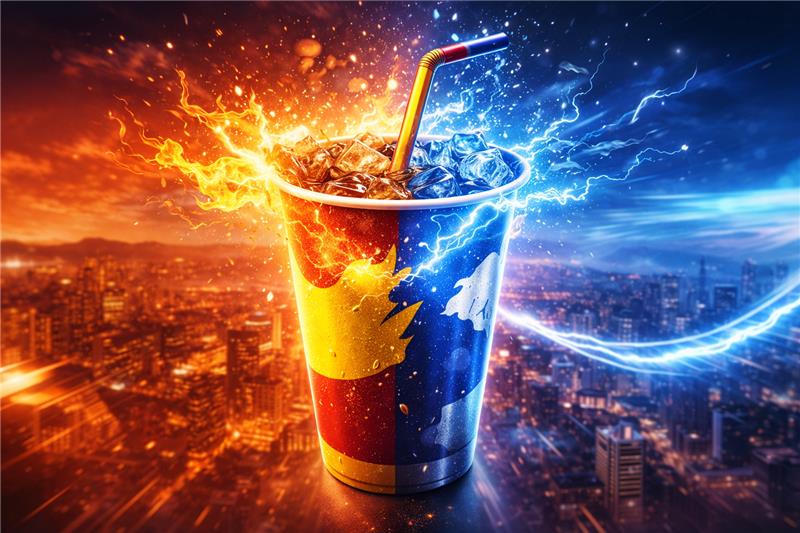
This isn’t a menu update—it’s a cultural alignment built around energy, identity, and daily momentum.
A Cultural Pivot Disguised as a Beverage Strategy
The integration of McDonald’s and Red Bull represents a calculated shift in how a global brand stays relevant in a rapidly evolving consumer landscape. McDonald’s is not simply adding an energy drink to its lineup; it is stepping directly into the behavioral patterns of Gen Z consumers who operate in a world defined by constant movement. This generation doesn’t separate food, energy, and lifestyle into different categories—they experience them as one continuous flow. By aligning with Red Bull, McDonald’s is positioning itself inside that flow instead of sitting outside of it.
This move reflects awareness rather than reaction. McDonald’s understands that the traditional structure of consumer engagement—centered around meals—is no longer enough to sustain dominance. The modern consumer moves based on energy levels, not just hunger. Red Bull already carries cultural authority in that space, representing performance, pace, and endurance. When McDonald’s brings that identity into its ecosystem, it expands its relevance from feeding people to fueling them, and that distinction changes how the brand is perceived.
From Meal Occasions to Momentum-Based Behavior
For decades, McDonald’s thrived by owning specific moments in the day—breakfast runs, lunch breaks, and late-night cravings. But Gen Z does not operate within those defined boundaries. Their schedules are fluid, their routines are unpredictable, and their decisions are driven by immediate needs rather than structured habits. That shift creates a new kind of opportunity, one where brands must fit into moments rather than define them.
Red Bull gives McDonald’s access to those in-between moments. The afternoon energy drop, the late-night push, the early-morning restart—these are not traditionally “meal moments,” but they are high-frequency engagement opportunities. By integrating an energy product into its system, McDonald’s becomes relevant in those spaces without forcing behavior. Instead of asking the consumer to adjust, the brand adapts to the consumer’s reality, and that adaptability is what keeps it competitive.
Scaling Culture Through Global Accessibility
Red Bull brings cultural relevance. McDonald’s brings global reach. That combination creates a powerful dynamic where something that already resonates with younger audiences becomes accessible on a massive scale. Red Bull has built its identity within high-energy environments—music, sports, and performance-driven culture. McDonald’s takes that same energy and distributes it across a network that exists in nearly every community.
This is how a brand scales culture without diluting it. McDonald’s does not need to reinvent Red Bull’s identity; it simply amplifies it. The result is a product that feels culturally authentic while still being widely available. That balance is difficult to achieve, but when executed correctly, it allows a brand to remain both familiar and current at the same time.
A Long-Term Strategy Built on Frequency and Presence
The deeper value of this move lies in frequency. Energy drinks create repeat engagement because they fit into multiple points throughout the day. Unlike meals, which require time and intention, beverages can be consumed quickly and frequently. That increases the number of interactions a consumer has with the brand, and over time, those interactions build loyalty.
McDonald’s is not just increasing its product offerings—it is increasing its presence in the daily lives of its customers. By aligning with Red Bull, it creates a system where engagement happens naturally and repeatedly. That is a long-term strategy designed to maintain relevance in a market where attention is constantly shifting, and it positions McDonald’s to remain a central part of consumer behavior for years to come.