by Jonathan P-Wright | Nov 10, 2023 | Business News, Latest |
Image credit: Sundry Photography / Shutterstock.com
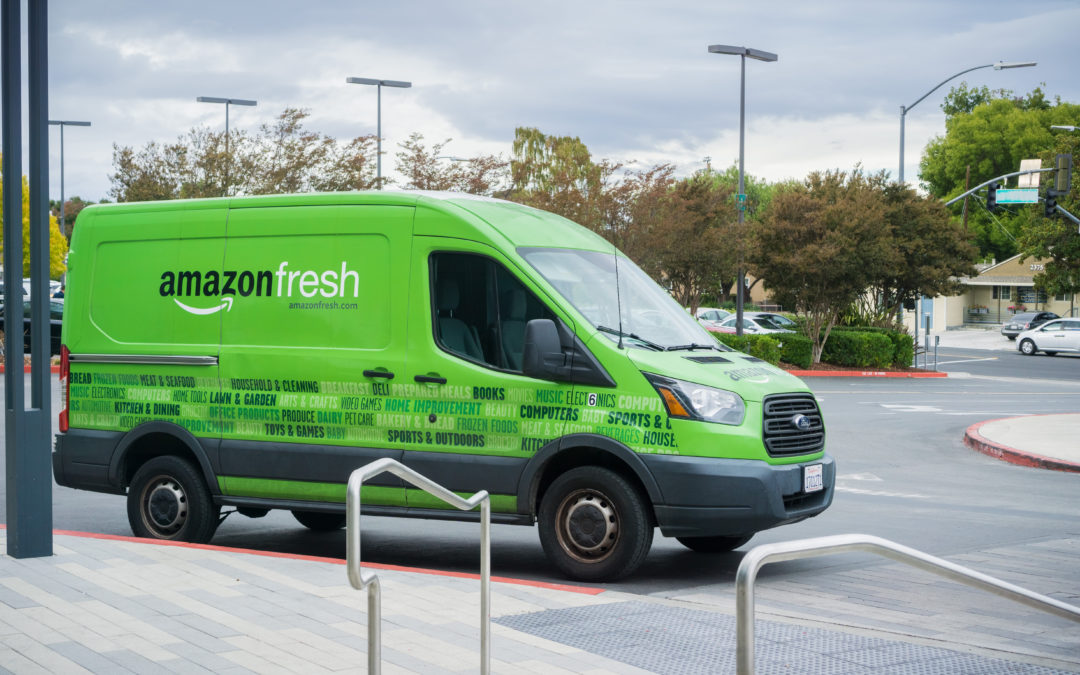
Amazon, the e-commerce giant, is altering its grocery delivery model in a bid to stay competitive in the rapidly evolving online grocery landscape. The company’s revised strategy for its grocery service, Amazon Fresh, could prove to be a significant turning point in the industry.
A Shift Towards Inclusivity
Amazon has announced changes to its grocery delivery service, Amazon Fresh, aiming to make it more competitive with rivals like Instacart, Walmart, Target-owned Shipt, and DoorDash. The most significant alteration? Customers no longer need an Amazon Prime membership to order groceries for delivery or free pickup from Amazon Fresh.
This move allows non-Prime members to avail themselves of Amazon Fresh’s services, giving the company a broader customer base. It is expected to roll out in locations across the U.S., where Amazon Fresh is offered, and soon, a similar option will be made available to Whole Foods shoppers.
Expanded Service and Delivery Options
According to the company, once this expansion phase is completed, customers in more than 3,500 U.S. cities and towns will have the option of ordering two-hour grocery delivery from either Amazon Fresh or Whole Foods Market, depending on availability.
In addition to this, Amazon shoppers can now order from local grocers and specialty shops through the Amazon website. These include stores like Bristol Farms, Cardenas Markets, Pet Food Express, Weis Markets, and Save Mart.
Pricing and Discounts
While Amazon Fresh is not a free service, even for Prime members, Amazon’s membership program will offer several discounts. For example, Fresh orders over $100 will still be free if you have a Prime membership, and won’t include a delivery fee. Meanwhile, two-hour deliveries will include a service fee of $6.95 for orders ranging from $50-$100, and $9.95 for deliveries under $50, for Prime members.
Non-members will be charged between $7.95-$13.95 depending on their basket size and the delivery window selected. Flexible orders with delivery times of up to six hours may also receive a fee reduction, while rushed orders may include additional fees.
Grocery Pickup and More
For grocery pickup with Amazon Fresh, the company offers stores in California, Illinois, Maryland, New Jersey, New York, Pennsylvania, Virginia, Washington, D.C., and Washington State. Some of these stores will also offer Amazon’s cashierless payment option, Just Walk Out where customers pay with a palm reader.
Both Amazon Fresh stores and Whole Foods Market locations can also be used for package pickup and return for Amazon.com orders, and those using this service in Fresh stores will receive coupons to use in-store.
The Bigger Picture: Amazon’s Grocery Market Position
This significant move of broadening Amazon’s grocery reach is indicative of how far Amazon has fallen behind in the broader online grocery market. Operating different grocery brands has led to consumer confusion — particularly in markets where both services are available with their own unique product selections.

by Enaysha Thompson | Sep 12, 2023 | Business News, Latest, Tech News |
Image Credit: Photo by Roberto Nickson on Unsplash
The autonomous driving scene in Europe is about to get shaken up. Deeproute.ai, an autonomous driving startup headquartered in Shenzhen, China, has plans to set up an operations center in Germany by 2024. The company, which has received over $350 million in funding and employs more than 500 employees worldwide, is the latest Chinese mobility upstart to establish a physical presence in Germany, home to some of the world’s largest automakers.
The move marks a significant step in the company’s global expansion strategy, which aims to collaborate with more local automakers and support OEM partners on smart driving mass production.
Unveiling The Plan
The announcement came during the International Motor Show Germany in Munich, where several Chinese mobility players marked their presence. The company has also revealed its plans to roll out its production-ready autonomous driving solution in Germany next year, with other European markets to follow.
Tech Behind The Wheel: Drive 3.0
The solution, dubbed Drive 3.0, works without HD maps and includes features like valet park assist. With a competitive hardware price of $2,000, the system is quite compelling. This affordability is largely thanks to Deeproute’s collaboration with its competitively priced Chinese lidar suppliers. Powering the system is Nvidia’s Drive Orin system-on-a-chip.
The Operations Center: A Mystery Unfolding
Details about the operations center remain sparse at this point. Deeproute has shared that it plans to hire a business development team in Germany, but the specifics about the operations center’s roles and responsibilities, as well as its geographical location, are yet to be disclosed.
Learning From History: Momenta’s Foresight
It’s worth noting that Deeproute is not the first Chinese autonomous driving company to establish a base in Germany. Suzhou-based competitor Momenta had the foresight to open an office in Stuttgart two years ago. This strategic move arguably paved the way for Momenta to foster closer relationships with its investor Mercedes-Benz, as well as other European OEMs.
Nio’s Footprint in Germany: A Case Study
Nio, another Chinese premium electric vehicle startup, already has a 1,500-sqm innovation center in Berlin and a design facility in Munich. In addition to these, it also runs a “Nio House,” a stylish members’ club and showroom in the German capital.
Deeproute’s Strategic Shift: From Robotaxi to Production-Ready Car
Like many ambitious Chinese AV startups, Deeproute initially focused on Level 4 driverless technologies to power robotaxis. However, over time, the company shifted its focus to less advanced driving solutions for auto partners, which could generate immediate cash flow. A representative from the company explained that they have been working with OEMs on mass production since last year, which prompted the shift in focus.
Deeproute’s Expanding Customer Base
As of the end of 2022, Deeproute’s services had provided over 800,000 passenger rides, most of which were executed by its robotaxis in major Chinese cities. With its impending expansion into Germany, the company hopes to grow its OEM customer base, which already includes Seres and Geely. A local business development team will be instrumental in connecting with more local automakers.
The Road Ahead: More Chinese Companies to Follow?
With Deeproute’s planned expansion, it’s possible that more Chinese robotaxi companies will consider venturing into Germany. If successful, Deeproute could potentially pave the way for other companies to follow suit, further solidifying China’s presence in the global autonomous driving landscape.

by Derrick T Lewis | Jun 2, 2021 | Business News, Latest, Tech News |
People are saying all kinds of different things about this month’s cyberattack on Colonial Pipeline’s operations, but one thing is for sure, this attack made every American aware of their extreme dependence on a company they’ve never even heard of. Many things need to be talked about this cyberattack, but the name of the company “Colonial” pipeline became a hot debate across the country.
Of all the things that are wrong with the company and it’s name, the branding of the company and its logo is the most disturbing. It is safe to say that the company didn’t bother to do anything about it’s logo and branding since the days of the Kennedy administration while the world kept moving on and kept spending on their branding and advertisement.
Let’s talk a little bit more about the history of this company and try to scratch the reason behind the boring and outdated logo of the company and why they didn’t care about the branding of their company at all.
Shall we?
Nine oil companies in the year 1961 started a joint venture and created a pipeline. The basic purpose of this pipeline was to deliver fuel from Houston to New York without any hurdle. That was the time when marketing was not the utmost priority for companies that were not in the eyes of the public and silently doing their important work for the citizens. Therefore, the branding and naming of the company were considered irrelevant to the public.
However, there was a small private concern that the name of the company should have some relevance and hint of American gravitas, and they thought that the word “Colonial” will do the trick, and somehow it actually did. Therefore, the original and more bulky name “Suwannee Pipe Line Company” was replaced with “Colonial Pipeline” in 1962, and it’s still the same in 2021.
You might already know that back in the day, terms like “National” and “Federal” were used to express the gravity of any company or institute. So, with that logic, the word “Colonial” did just the trick as two of the states that this pipeline was going to connect are the original of the thirteen colonies. However, at the start of the sixties, “Colonial” started to sound like an outdated term, and no one was quite very happy with the name of the companies that had this word in them. It is the reason that trademark office record shows a decline of usage of the word from 0.027% to 0.007% in logos of companies.
In today’s world, this word sounds straight away bad and geriatric. People have long realized the negative connotations attached to this word, and they start to see through the strategy of the great empires to colonize the weak and oppress them, and they are calling them out in 2021. Therefore, when the cyberattack happened, and the name of the pipeline company started to make headlines, Americans were not really happy with it.
But, let’s just forget about the name of the company for a while for argument’s sake and have a look at the logo of the company. The logo of the company is its initials “CP” within a cross-sectional view of the pipeline. Given the logo trends in the sixties, it is a pretty clean and clever logo. However, if you see it now, you’ll find it strangely odd and outdated. On the contrary, different companies that had direct customer dealing or are directly relevant with the life of consumers made a lot of effort in improving their logos through their branding campaigns like that of Coca-Cola and General Electric.
So, the real question is why “Colonial Pipeline” didn’t bother to invest in the branding of the company and work on its logo or name, for that matter, until it became a controversy? The answer is simple. The company was silently doing its work, and there was no direct relation of the consumer with the company in their everyday life. Therefore, they never really cared about the need for time and changing their name or logo according to modern standards. It is safe to say that if they had to deal directly with their consumers or if they had a direct customer base, they would have changed it for good a long time ago.
If the past few weeks have revealed anything about the company, it’s that it has failed to meet the modern standards, and it’s pretty outdated. Had it been the center of the public eye, they would have worked on its name and logo and took the branding of the company more seriously.
So, if this cyberattack revealed one thing, its that the branding, especially the name and the logo of company holds a significant importance that is quite often overshadowed by window dressings.
Therefore, from now on, let’s not forget that name and the logo of any brand is the biggest representative of nature and ideology that a company represents. Let this crisis be a lesson for all of us, and may we always be able to stand on the right side of history.
This article was penned by Jonathan P. Wright. Jonathan is a freelance writer for multiple mainstream publications and CVO of RADIOPUSHERS. You can read more of his work by clicking here.
by Jonathan P-Wright | Apr 20, 2026 | Business News, Latest |
This isn’t a menu update—it’s a cultural alignment built around energy, identity, and daily momentum.
A Cultural Pivot Disguised as a Beverage Strategy
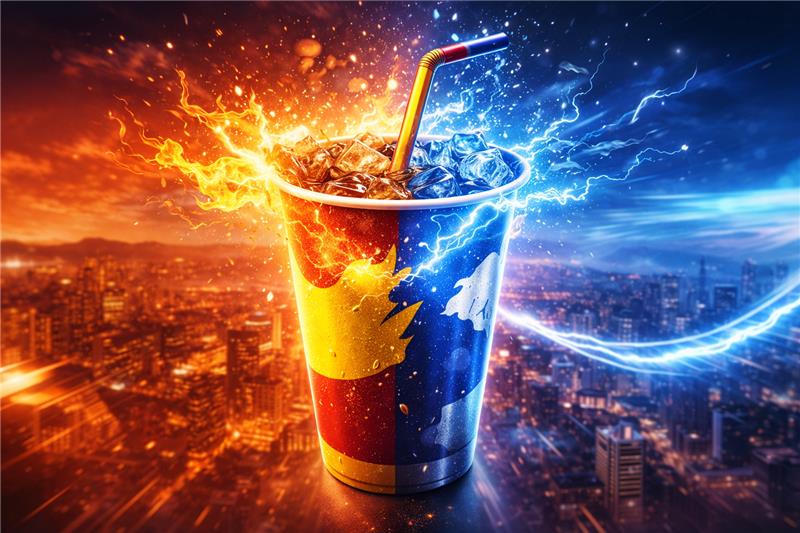
The integration of McDonald’s and Red Bull represents a calculated shift in how a global brand stays relevant in a rapidly evolving consumer landscape. McDonald’s is not simply adding an energy drink to its lineup; it is stepping directly into the behavioral patterns of Gen Z consumers who operate in a world defined by constant movement. This generation doesn’t separate food, energy, and lifestyle into different categories—they experience them as one continuous flow. By aligning with Red Bull, McDonald’s is positioning itself inside that flow instead of sitting outside of it.
This move reflects awareness rather than reaction. McDonald’s understands that the traditional structure of consumer engagement—centered around meals—is no longer enough to sustain dominance. The modern consumer moves based on energy levels, not just hunger. Red Bull already carries cultural authority in that space, representing performance, pace, and endurance. When McDonald’s brings that identity into its ecosystem, it expands its relevance from feeding people to fueling them, and that distinction changes how the brand is perceived.
From Meal Occasions to Momentum-Based Behavior
For decades, McDonald’s thrived by owning specific moments in the day—breakfast runs, lunch breaks, and late-night cravings. But Gen Z does not operate within those defined boundaries. Their schedules are fluid, their routines are unpredictable, and their decisions are driven by immediate needs rather than structured habits. That shift creates a new kind of opportunity, one where brands must fit into moments rather than define them.
Red Bull gives McDonald’s access to those in-between moments. The afternoon energy drop, the late-night push, the early-morning restart—these are not traditionally “meal moments,” but they are high-frequency engagement opportunities. By integrating an energy product into its system, McDonald’s becomes relevant in those spaces without forcing behavior. Instead of asking the consumer to adjust, the brand adapts to the consumer’s reality, and that adaptability is what keeps it competitive.
Scaling Culture Through Global Accessibility
Red Bull brings cultural relevance. McDonald’s brings global reach. That combination creates a powerful dynamic where something that already resonates with younger audiences becomes accessible on a massive scale. Red Bull has built its identity within high-energy environments—music, sports, and performance-driven culture. McDonald’s takes that same energy and distributes it across a network that exists in nearly every community.
This is how a brand scales culture without diluting it. McDonald’s does not need to reinvent Red Bull’s identity; it simply amplifies it. The result is a product that feels culturally authentic while still being widely available. That balance is difficult to achieve, but when executed correctly, it allows a brand to remain both familiar and current at the same time.
A Long-Term Strategy Built on Frequency and Presence
The deeper value of this move lies in frequency. Energy drinks create repeat engagement because they fit into multiple points throughout the day. Unlike meals, which require time and intention, beverages can be consumed quickly and frequently. That increases the number of interactions a consumer has with the brand, and over time, those interactions build loyalty.
McDonald’s is not just increasing its product offerings—it is increasing its presence in the daily lives of its customers. By aligning with Red Bull, it creates a system where engagement happens naturally and repeatedly. That is a long-term strategy designed to maintain relevance in a market where attention is constantly shifting, and it positions McDonald’s to remain a central part of consumer behavior for years to come.

by Pharron Fields | Aug 21, 2025 | Business News, Latest, Music News |
Photo by Frankie Cordoba on Unsplash
For over a decade, digital streaming platforms have dominated the way people discover and consume music. They’ve revolutionized access, given listeners millions of songs at their fingertips, and provided artists—particularly independent ones—with the promise of a level playing field. But over the last couple of years, that promise has started to fade. A new movement is emerging among indie musicians: one that favors direct-to-consumer models over mainstream streaming platforms. This isn’t rebellion—it’s a response to economics, ownership, and a desire for long-term sustainability.
The Harsh Reality of Streaming Revenue
At first glance, streaming seems like a great way for artists to reach global audiences. A song can travel across countries overnight, algorithmic playlists can spike visibility, and listeners can easily find new artists. But for all its reach, streaming delivers little reward for most artists financially. Many musicians have realized that their play counts look impressive, but their income doesn’t match. That’s because the underlying payment structure doesn’t favor small-scale creators.
Streaming services operate on a revenue-sharing system. Each month, the platform calculates the total number of streams across all songs and divides the subscription revenue based on what percentage of plays each song received. This means artists are not paid per play in any fixed or reliable sense. Instead, they earn a slice of the monthly pie that gets smaller the more the platform grows and the more competitive the streamshare becomes.
This structure overwhelmingly favors major label artists and viral chart-toppers. For independent artists, it often translates to a payout of just a few dollars for thousands of streams. Spotify, one of the biggest platforms, typically pays between $0.003 and $0.005 per stream. At that rate, an artist would need roughly 333,000 streams to earn just $1,000. Meanwhile, even Apple Music and Amazon, which pay slightly better, still require over 100,000 streams to hit the same mark. With no flat rate, the income is not only low but also unpredictable.
Streaming Thresholds and the New Gatekeeping
In 2024, Spotify introduced a new policy that added insult to injury for small artists. Under this update, any song that fails to accumulate 1,000 streams in a 12-month window is excluded from royalty payments. The company positioned this move as a way to reduce low-quality uploads and fraudulent activity. But it had a side effect that hit legitimate indie artists the hardest—especially those with niche fanbases or smaller catalogs.
This policy pushed many artists to reassess their reliance on streaming. If your music isn’t hitting a certain level of volume, it’s now simply not worth anything to the platform, no matter how much effort went into it or how meaningful it is to fans. This effectively introduced a new form of gatekeeping. Not based on talent, but on numbers.
Rethinking Value: Why Artists Are Selling Direct
In light of these challenges, a wave of musicians is finding new hope in older models—with a modern twist. Selling music, merch, and experiences directly to fans has emerged as a powerful alternative to the streaming economy. When artists go direct, they not only get paid more per transaction, but they also regain a sense of control and connection that streaming cannot offer.
Let’s break down the math. If an artist sells 200 digital albums at $10 each through their own site or a DTC platform, and keeps 80% of the revenue, they take home $1,600. That’s more than what they’d earn from hundreds of thousands of Spotify streams—and they get paid faster, often within a couple of days. This model puts the artist back in charge. They set their own price, keep the data, and engage their audience on their terms.
Owning the Fan Relationship Is the Game-Changer
Perhaps the biggest advantage of the direct model is access to fans. Streaming platforms are designed to keep users inside the app. They don’t share listener data with artists, which means the musician never truly knows who their fans are. They can’t reach out directly, promote shows, or sell merchandise easily. They just have to hope the algorithm favors them again.
Going direct changes this dynamic completely. When someone buys music from an artist’s store or a DTC platform, the artist gets their contact information. They can now build an email list, send SMS updates, and keep fans informed about new projects or tour dates. This turns passive listeners into loyal supporters—and those relationships last far longer than a playlist add.
Some platforms even include built-in CRM (customer relationship management) tools that make it easy to segment fan lists and create custom campaigns. Artists can reward top fans, run promotions, or offer exclusive content. This isn’t just marketing—it’s community-building. And that’s something no streaming platform can replicate.
Scarcity and Exclusivity as Revenue Multipliers
One of the most effective strategies in the direct-to-consumer model is using scarcity to drive action. Artists are now releasing music as limited-time digital “drops” or exclusive early-access bundles before ever touching streaming platforms. Fans who want to be the first to hear new songs are encouraged to buy rather than wait. This urgency turns first-week hype into real money and helps fund future releases.
Artists can also experiment with tiered pricing. For example, they might offer a basic album for $10, a deluxe edition for $25 with bonus tracks, and a $50 VIP package that includes a video call or signed item. Fans love the chance to support artists in meaningful ways—and artists earn far more per fan compared to what streaming provides.
Ethics and Brand Alignment Matter Too
For some musicians, this shift is not just about revenue but about values. Large streaming platforms make business decisions that may clash with an artist’s beliefs—whether it’s partnerships with controversial companies, investment in industries like defense tech, or failure to support marginalized communities. Selling direct gives artists the freedom to run their business in a way that aligns with their personal ethics.
When artists own the entire sales process, they’re no longer beholden to corporate policies or opaque algorithms. They get to decide what they release, how they price it, and who they serve. This creative and ethical freedom is invaluable for many.
The Rise of Artist-Centric Platforms
New tools are making it easier than ever for artists to make the shift. EVEN and Nebula are two standout platforms helping lead the way. EVEN allows musicians to sell digital releases, merch, and bundled experiences directly to fans. Artists can customize pricing, capture fan data, and use built-in marketing features to manage ongoing campaigns.
Nebula takes a different angle. It uses blockchain technology to let fans buy fractional ownership of songs. In return, they earn a share of the royalties generated by the music. This turns listeners into stakeholders and allows artists to raise funding without signing away rights to labels. It’s a bold new model for community-funded creativity.
Both platforms prioritize independence. They’re designed not to replace streaming, but to give artists more tools to succeed outside it. And the best part? They let artists decide how much or how little they want to use traditional DSPs in their strategy.
A Smarter Strategy for a Changing Industry
Many indie artists are adopting a hybrid approach. Instead of abandoning streaming altogether, they’re reframing it. Streaming becomes a discovery tool, not the primary monetization method. New music is released first through a paid drop on the artist’s own site or platform, where the core audience can buy it and support the artist directly. Afterward, it’s released to streaming for visibility and algorithmic traction.
This strategy allows artists to earn upfront from their biggest supporters and still reach wider audiences later. It’s not about rejecting the mainstream—it’s about making it work for you, on your own terms.
Direct Sales Aren’t Just for Albums
The beauty of the DTC model is that it extends far beyond just selling music. Artists can bundle their releases with behind-the-scenes content, virtual meet-and-greets, concert tickets, merch, or even fan-only community access. These experiences increase the value of each transaction and deepen the fan connection.
At live shows, artists can sell limited edition merch or use QR codes to drive traffic to their digital storefronts. The same principle applies online: every post, livestream, or tweet becomes an opportunity to guide fans to a space the artist owns.
Where Things Are Headed
As the music landscape continues to evolve, more independent artists are realizing they don’t have to play by the rules set by streaming giants. The tools for independence are finally here. And while streaming platforms will continue to dominate mass consumption, they no longer have to dominate the business of being an artist.
The DTC movement isn’t just a trend—it’s a fundamental shift in how artists think about their careers. It’s about turning fans into partners, attention into income, and data into long-term opportunity. In a world where streams rarely pay the bills, selling direct might just be the future of music for those who want to stay creative, stay independent, and stay in business.

RECENT COMMENTS